
When Three Voices Talked at Once: Dana's Panel Recording
Marcus Delaney
5 minutes to read
A short case from the course: Dana, who runs events for a community college, brought a panel recording where speakers kept interrupting each other, and we worked out how to label it.
The recording Dana brought in
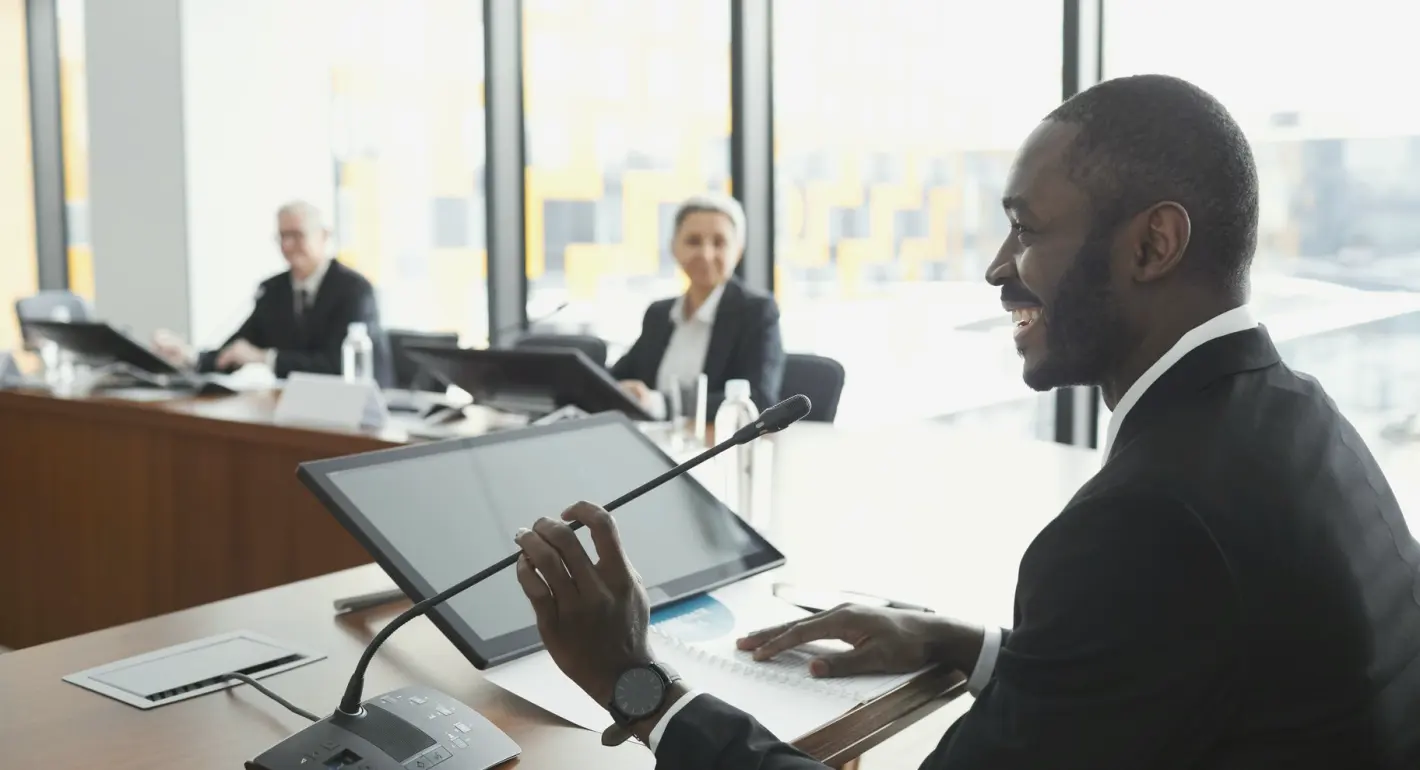
Dana came to one of our Tulsa sessions in the first weeks of the autumn term. She coordinates events for a community college and had a ninety-minute panel recording from a spring forum, with four speakers and a moderator, that she wanted to caption herself. She had already tried a first pass and showed it to me on her laptop. The words were mostly right, but every line began with a dash and nothing told the viewer who was talking.
I asked her to play me two minutes without looking at the text. Within thirty seconds she lost track of who had said what, and that was exactly the problem a viewer would face with her draft. Captions that get the words right but leave out the speaker force people to guess, and on a panel the guessing gets worse the longer it runs.
We agreed that the goal was not a perfect transcript on the first try. It was a version where a person who cannot hear the audio could follow the discussion from the text alone.
Building a speaker list before typing
The first thing we did was stop typing. I had Dana listen to the opening ten minutes and write down every voice she could distinguish, along with anything that helped her recognize it: pace of speech, a habitual phrase, the seat position mentioned by the moderator. She ended up with five entries on a sheet of paper.
Then we matched names to voices using the event program she had saved. This is the step beginners tend to skip, and it saves the most rework later. Once the list existed, she knew in advance whether to write a full name, a role, or only a first name, and she could choose one style and keep it for the whole file.
Dana decided to use first and last names on first appearance and last names alone afterwards, which is a common and readable convention for panel material.
- Listen to the opening minutes with no text on screen
- Write one line per voice with a memory aid
- Match names using the event program or sign-in sheet
- Fix the labelling style before the first caption
Where the overlap happened
The hard part came about forty minutes in, when two panelists disagreed about a funding question and spoke across each other for nearly half a minute. Dana's first instinct was to type everything both people said in the order she heard it. On the page that produced a jumble of half sentences that belonged to nobody.
We slowed the playback and separated the two strands. One speaker made a complete point that the audience clearly heard; the other made a shorter remark that was partly drowned out. We gave the complete point its own caption with a label, then placed the interjection in a second caption that followed, marked as the other speaker cutting in.
She asked whether that was cheating the timeline. It is not. Viewers read in sequence, and a clean order that reflects who was understood is more honest than a pile of fragments.
Choices Dana made along the way
Several small decisions came up that afternoon, and we talked through each one rather than settling on a rule. When the moderator spoke off camera, should the label say moderator or use the person's name? Dana chose the name, since the audience had been introduced to it. When a speaker laughed before answering, did that deserve a note? She left it out, because the laugh carried no information that the words did not.
An audience question asked from a seat without a microphone was the trickiest. The voice was faint and the person was never named. We labelled it as an audience member and kept the wording close to what could be reliably heard, marking one unclear word instead of guessing.
None of these choices is the only correct one. What mattered was that she made them on purpose and wrote them down so the next file would match.
- Name or role for off-camera voices
- Whether laughter or pauses add meaning
- How to label an unnamed audience member
- How to mark a word that cannot be made out
The second pass and what changed
Dana went home and reworked the full recording over the following week. When she returned, she brought the file and we reviewed twenty minutes of it together, reading the captions aloud as a viewer would. Almost every line now began with a clear label, and the overlapping stretch around the funding discussion read as a conversation rather than a tangle.
We still found problems. In one place two panelists with similar voices had swapped labels for about a minute, which she caught only because the content no longer made sense. That kind of error is easy to make and easy to miss, so we added a step: read the captions for each speaker on their own and check that the thread of their argument holds together.
She also trimmed a few labels that had become repetitive when the same person spoke across several consecutive captions, keeping the label only where the speaker changed.